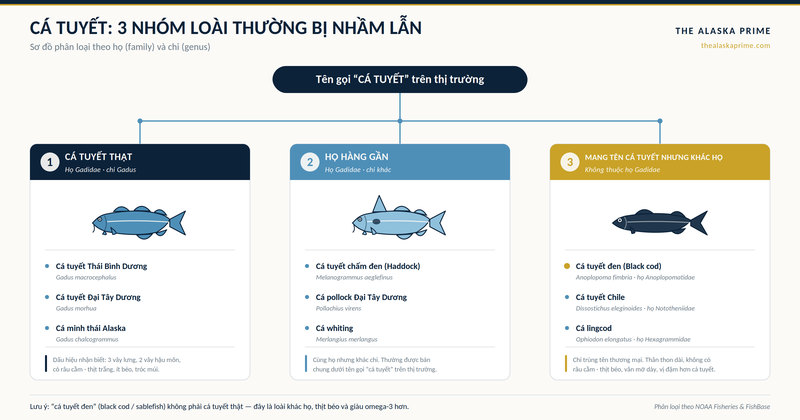
True cod means fish in the genus Gadus, family Gadidae — primarily Atlantic cod (Gadus morhua), Pacific cod (Gadus macrocephalus), and Greenland cod (Gadus ogac). But at least five more species sell under the "cod" name without belonging to that family at all — most notably black cod, also called sablefish. Understanding that distinction is the only reliable way to avoid buying the wrong fish.
What Is Cod, Exactly?
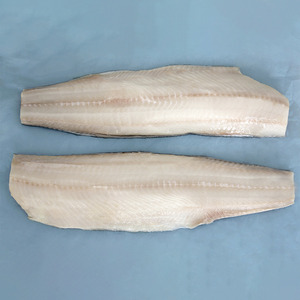
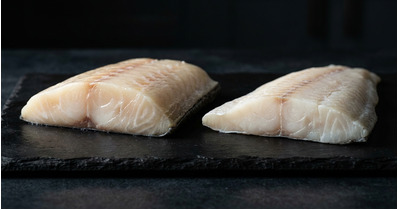
Cod is the common name for cold-water, white-fleshed marine fish in the Gadidae family of the Northern Hemisphere. The group shares a profile: white, lean flesh with fine flakes, low fat content, and a mild flavor.
The complication is that "cod" is a broad market name. It gets applied to species that aren't cod at all, in English just as much as in other languages.
Scientifically, the tiers work like this:
- True cod = species in the genus Gadus
- The cod family (Gadidae) = broader, also covering haddock, whiting, pollock, and saithe
- "Cod" as a market name = broadest of all, stretching to species from entirely different families, like sablefish
That gap between the scientific tier and the market tier is where nearly every mislabeling problem originates.
How Many Types of Cod Are There?
|
Group |
Definition |
Common species |
Widely sold? |
|
Group 1 — True cod |
Genus Gadus, family Gadidae |
Atlantic cod, Pacific cod, Greenland cod |
✅ Yes |
|
Group 2 — Close relatives |
Family Gadidae, different genus |
Haddock, Alaska pollock, saithe/coalfish, whiting |
✅ Yes |
|
Group 3 — "Cod" in name only |
Market name includes "cod," family is entirely different |
Sablefish (black cod), lingcod, rock cod |
✅ Sablefish especially |
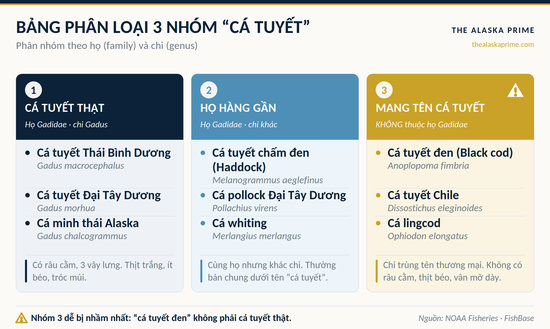
The key point: black cod — the most premium and most expensive fish on this list — isn't true cod at all. It belongs to Anoplopomatidae, a completely separate family.
Species ID Table — 8 Fish Sold as "Cod"
Use the scientific name as your reference. Common names and market names both drift.
|
Common name |
Market name |
Scientific name |
Family |
How to identify |
|
Black cod |
Sablefish |
Anoplopoma fimbria |
Anoplopomatidae |
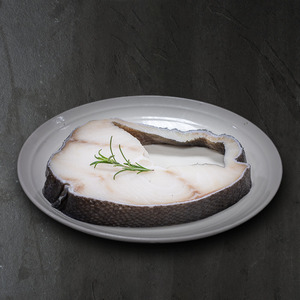
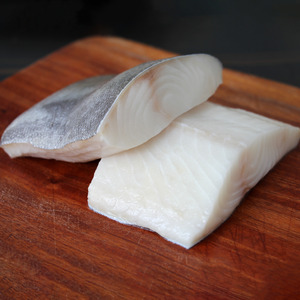
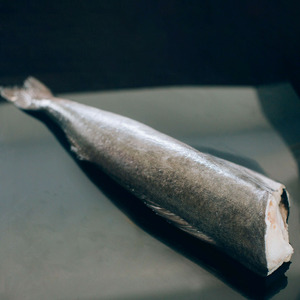
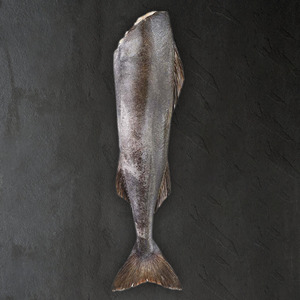
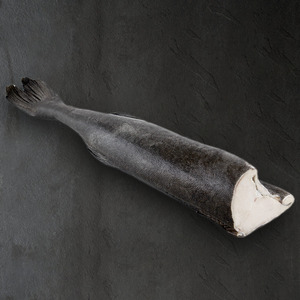
Black skin with blue sheen, white marbling, rich buttery flesh, highest price |
|
Pacific cod |
True cod, gray cod |
Gadus macrocephalus |
Gadidae |
Mottled gray-brown skin, lean white flesh, chin barbel |
|
Atlantic cod |
Cod, scrod |
Gadus morhua |
Gadidae |
Pale lateral line, chin barbel, lean white flesh |
|
Greenland cod |
Ogac |
Gadus ogac |
Gadidae |
Smaller, Arctic range, rarely traded commercially |
|
Alaska pollock |
Pollock |
Gadus chalcogrammus |
Gadidae |
Fine white flesh, very lean, primary surimi raw material |
|
Haddock |
Haddock |
Melanogrammus aeglefinus |
Gadidae |
Dark shoulder patch, finer flake than cod |
| Saithe |
Coalfish, pollock |
Pollachius virens |
Gadidae |
Dark back, grayish raw flesh that whitens when cooked |
| Lingcod | Lingcod |
Ophiodon elongatus |
Hexagrammidae |
Large head and mouth, flesh sometimes naturally blue-green |
Sources: FishBase, NOAA Fisheries, Alaska Department of Fish and Game.
Two name collisions worth knowing:
- Sablefish vs. saithe. Saithe's English market name is "coalfish," which translates into several languages as something close to "coal cod" — colliding directly with an alternate name for sablefish in Vietnamese. Completely different fish, completely different price tier.
- "Pollock" means two fish. Both Gadus chalcogrammus (Alaska pollock) and Pollachius virens (saithe) trade as "pollock" depending on the market.
What Is Black Cod and Why Is It Its Own Category?
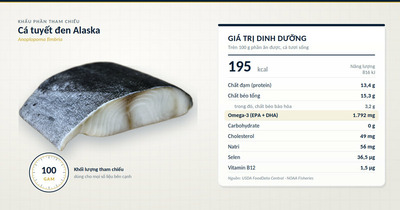
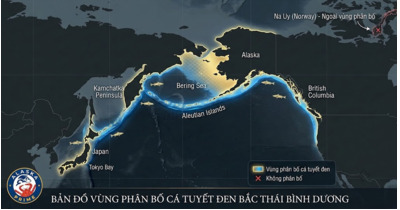
Black cod (Anoplopoma fimbria) isn't in the cod family. It carries the "cod" name for commercial reasons. It belongs to Anoplopomatidae, lives only in the North Pacific at depths of 300 to 1,500 meters, and can live more than 90 years.
Why it stands apart and commands the highest price on this list:
- Far higher fat content: roughly 15.3g per 100g, versus 0.4–0.6g in true cod
- Very high omega-3s: about 1,790mg of EPA+DHA per 100g, in salmon territory
- A completely different texture: silky, buttery, large-flaked, where true cod is firm, lean, and fine-flaked
- Limited stock, difficult harvest: longline-caught in deep water and managed under individual quotas
Short version: black cod and true cod share white flesh and nothing else. Full breakdown in our guide to black cod vs. regular cod.
Atlantic Cod vs. Pacific Cod
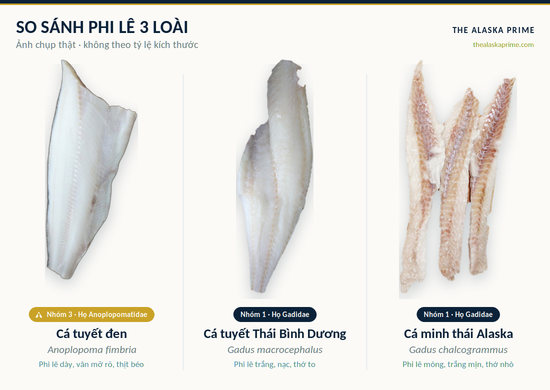
Both are true cod, nearly interchangeable in the kitchen, but they differ in waters and stock status.
| Factor |
Atlantic cod |
Pacific cod |
|
Scientific name |
Gadus morhua |
Gadus macrocephalus |
| Waters |
North Atlantic (Norway, Iceland, Canada) |
North Pacific (Alaska, Japan, Russia) |
|
Typical size |
Larger |
Smaller, proportionally larger head |
| Texture |
Slightly larger flake, moister |
Firmer, finer flake |
| Moisture | Higher |
Lower — better for frying |
|
Stock status |
Historically depleted, recovering in some areas |
Stable and well-managed in Alaska |
|
Relative price |
Higher |
More affordable |
For home cooks: the sensory gap between them is small. Pacific cod is usually the more practical pick — steady supply, strong sustainability management out of Alaska, and better value. See our Pacific cod selection.
Label Cross-Reference — Avoiding Mislabeled Fish
Match the name on the label against the scientific name. If they don't line up with this table, ask.
|
If the label says... |
The scientific name must be... |
If it isn't, it's... |
|
Black cod / sablefish |
Anoplopoma fimbria |
A different species — red flag |
|
Pacific cod |
Gadus macrocephalus |
A different species — red flag |
|
Atlantic cod |
Gadus morhua |
A different species — red flag |
|
Alaska pollock |
Gadus chalcogrammus |
Possibly Pollachius virens — ask |
| Sablefish |
Anoplopoma fimbria |
The most reliable name of the set |
Practical tip: on an import carton, the English trade name and the FAO catch area code are your two most trustworthy data points. Real sablefish always carries FAO Area 67 (Northeast Pacific). If a product labeled "black cod" shows FAO Area 27 (Northeast Atlantic), it's a different fish, full stop.
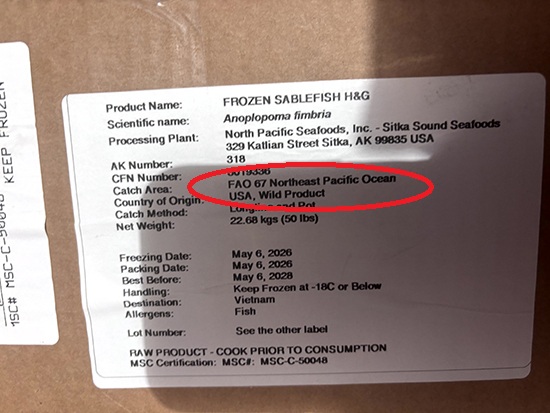
Full verification walkthrough in our guide on how to pick good black cod.
Which Cod Should You Buy?
Choose by dish and budget, not by name.
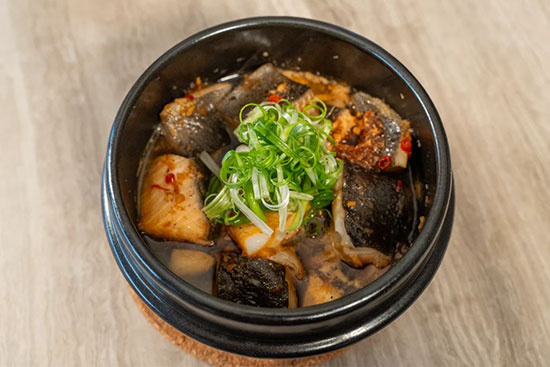
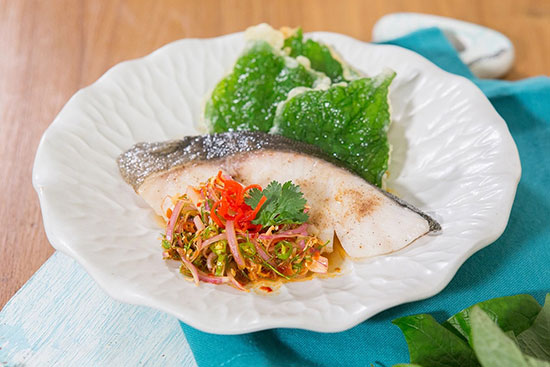
- Rich dishes — broiled, braised, or seared → black cod. It stays moist even if you overcook it. See Alaskan black cod.
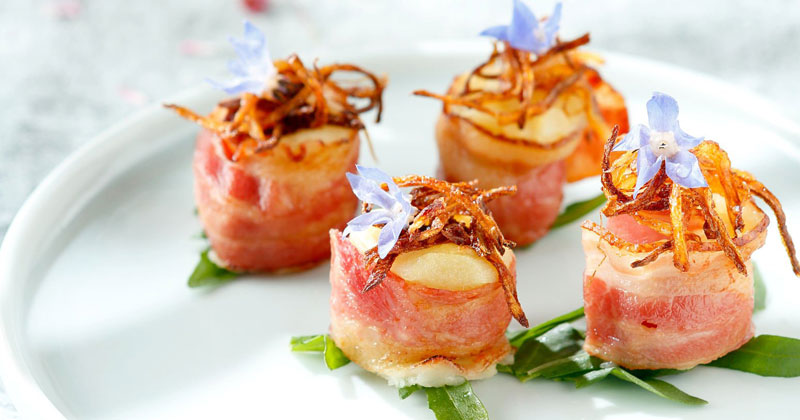
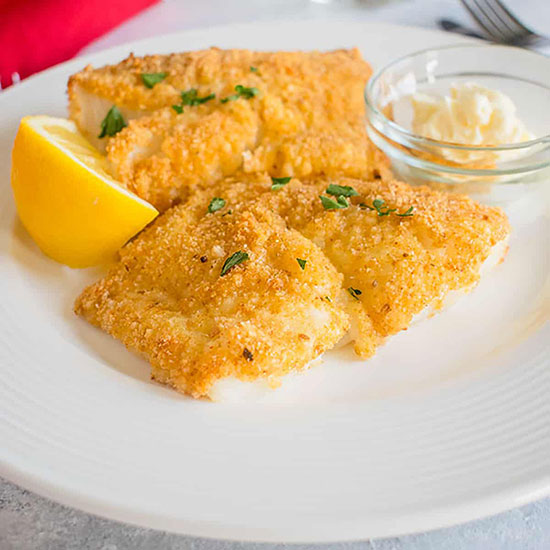
- Lean applications — fish & chips, soups, stews → Pacific cod. Clean flavor that won't make a broth greasy.
- Volume cooking and fish cakes → Alaska pollock. Fine white flesh that binds well and costs less.
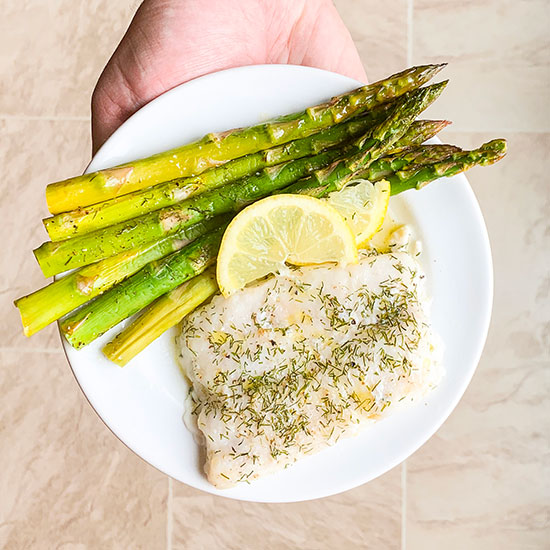
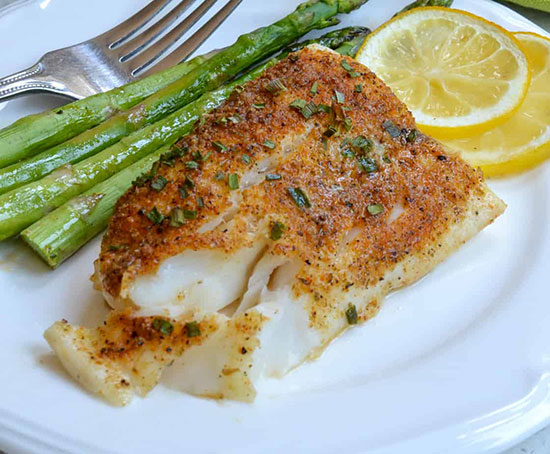
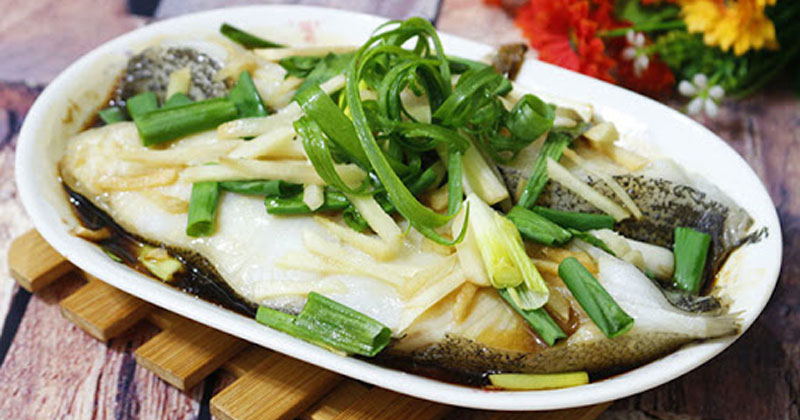
- Meals for kids and older adults → steamed black cod. Soft, few pin bones, DHA-dense.
Detailed nutrition comparisons in black cod calories and nutrition. Recipes at how to cook black cod. Full range at imported Alaskan fish.
Frequently Asked Questions
Is black cod actually cod? Scientifically, no. Black cod (Anoplopoma fimbria) belongs to the Anoplopomatidae family, not Gadidae. The name is a market convention from the early 1900s — white flesh sold better under a familiar name.
Is sablefish the same as black cod? Yes. Sablefish is the official name; black cod is the market name. Don't confuse either with saithe or coalfish, which are unrelated.
Is pollock a type of cod? Alaska pollock (Gadus chalcogrammus) sits in the same genus as true cod, so it's a very close relative. But it's used differently in the kitchen — mostly for surimi, fish cakes, and processed products.
Which type of cod tastes best? There's no single answer. Black cod is the richest and silkiest, and priced accordingly. But for battered fish or a clear soup, Pacific cod's lean, firm flesh works better.
Is Atlantic cod overfished? Several Atlantic cod stocks collapsed during the 20th century and are under recovery management in various regions. Alaska's Pacific cod stocks are currently assessed as stable and tightly managed.













)