"Alaskan lobster" is a familiar market name for North Atlantic clawed lobster — the species Homarus americanus, harvested mainly in Canada. In reality, Alaska has no commercial clawed lobster fishery. The species lives in the Northwest Atlantic, a continent away. So the product you're looking for under the name "Alaskan lobster" is Canadian lobster.
Shopping for lobster? What you want is Canadian lobster — officially imported, pre-cooked, available in 7 sizes from 350g to 1kg+.
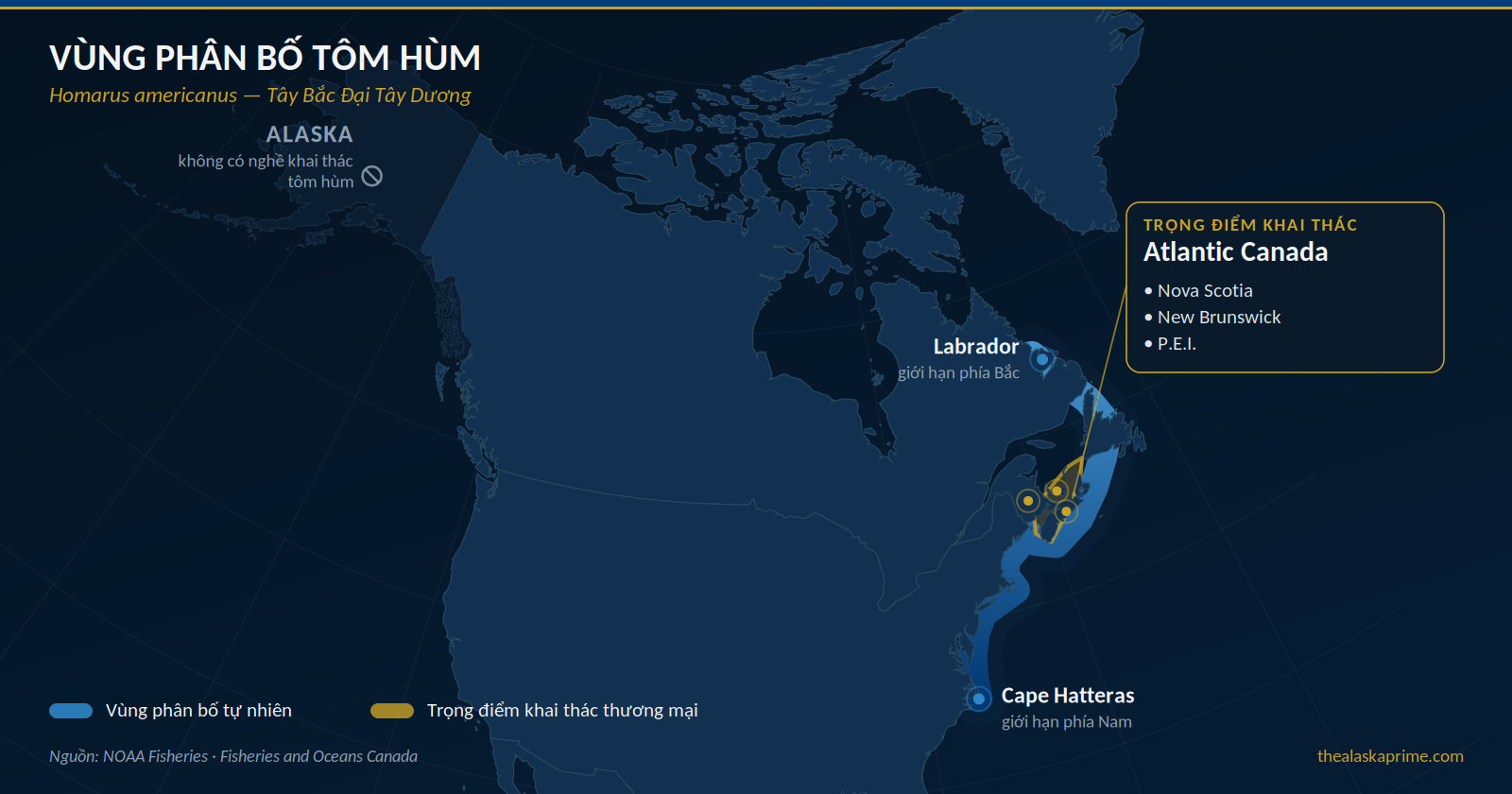
Does Alaska Have Lobster?
Not clawed lobster. Alaskan waters sit in the North Pacific, entirely outside the natural range of Homarus americanus.
Commercial clawed lobster lives in the Northwest Atlantic, from Labrador down to Cape Hatteras, North Carolina. The fishery concentrates in two regions:
- Atlantic Canada — Nova Scotia, New Brunswick, Prince Edward Island, Newfoundland, and Québec
- Maine, USA
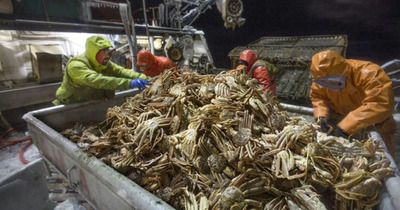
Alaska is famous for crab, not lobster: king crab, snow crab, and Jonah crab are the shellfish that actually come out of those waters.
Sources: NOAA Fisheries — American Lobster species profile; DFO Canada.
So Why Do People Call It "Alaskan Lobster"?
It's a naming habit, not a scam. Three things converged.
1. "Alaskan seafood" became a category label. In several Asian markets, "Alaska" drifted into use as shorthand for premium imported cold-water seafood rather than a strict point of origin. Alaskan king crab got famous first, and the label spread to other premium items — lobster included.
2. Same importers, same distribution channel. Companies specializing in Alaskan seafood typically bring in Canadian lobster through the same North American cold-water supply chain. Customers named the product after the supplier, and it stuck.
3. They genuinely taste similar. Canadian lobster and Alaskan shellfish are both cold-water products — sweeter and firmer than warm-water equivalents. Consumers grouped them by eating experience, not by map.
The result: "Alaskan lobster" became a high-volume search term for a product that doesn't geographically exist. When you search for it, what you actually want is Canadian lobster.
Name vs. Reality
|
What you hear |
What it actually is |
Note |
|---|---|---|
|
Alaskan lobster |
Canadian lobster (Homarus americanus) |
Alaska has no clawed lobster fishery |
|
Maine lobster |
Same species, harvested in Maine |
Same Homarus americanus, different jurisdiction |
|
Atlantic lobster |
Same species |
Named by ocean — scientifically accurate |
|
American lobster |
Same species |
The standard common name |
|
Canadian lobster |
Same species, harvested in Canada |
The most precise trade name for Canadian product |
|
Spiny lobster / rock lobster |
Different genus entirely (Panulirus) |
No large claws — see below |
|
Alaskan king crab |
Genuinely from Alaska |
Crab, not lobster |
What Is Canadian Lobster?
Canadian lobster is the clawed lobster Homarus americanus, family Nephropidae — the one with the big claws, living on cold Atlantic seabeds.
Identifying features:
- Two large asymmetric claws — a heavy crusher and a lighter cutter. This is the clearest way to tell it from spiny lobster
- Greenish-brown to dark shell when alive, turning bright red-orange when cooked
- Distinct claw meat and tail meat, both firm and sweet
- Lives on rocky bottoms, typically 4–50 meters down, in cold water year-round
On fishery management: Fisheries and Oceans Canada (DFO) divides the coast into Lobster Fishing Areas (LFAs), each with its own staggered season. Conservation measures include:
- Caps on licenses and traps per vessel
- Defined season lengths and permitted fishing days
- Total Allowable Catch quotas
- Minimum size limits — undersized lobsters go back
- Mandatory release of egg-bearing females
The Nova Scotia and New Brunswick inshore trap fishery (Bay of Fundy, Scotian Shelf, and Southern Gulf of St. Lawrence) holds MSC certification — independently assessed for sustainability. Canada's offshore fishery has been certified since 2010.
Sources: DFO Canada; Marine Stewardship Council; Lobster Council of Canada.
Clawed Lobster vs. Spiny Lobster
Two different groups. The claws give it away instantly.
|
Feature |
Canadian lobster |
Spiny / rock lobster |
|---|---|---|
|
Group |
Clawed lobster (Homarus) |
Spiny lobster (Panulirus) |
|
Large claws |
✅ Yes, prominent and asymmetric |
❌ None |
|
Antennae |
Short |
Very long, stiff, spiny |
|
Shell |
Smooth, greenish → red-orange cooked |
Spiky, often brightly patterned |
|
Waters |
Cold North Atlantic |
Tropical and subtropical |
|
Main meat |
Claws + tail |
Tail only |
|
Typical format |
Pre-cooked, frozen |
Live |
Which One Should You Buy?
If you came here searching for "Alaskan lobster," the product you want is Canadian lobster. It's exactly what people are describing when they use that name: big claws, sweet meat, cold water.
Every lobster at The Alaska Prime is officially imported Canadian lobster, pre-cooked and frozen, with complete origin documentation. Seven sizes, from 350g to over 1kg.
Sizing guide:
|
Occasion |
Size |
Why |
|---|---|---|
|
Trying it out, one person |
350g – 400g |
A single proper portion |
|
Dinner for two |
400g – 600g |
Best balance of meat and price |
|
Small gathering |
600g – 800g |
Presents well, serves several |
|
Special occasion |
800g – 1kg+ |
Bigger claws, more meat, best centerpiece |
Browse our full lobster range, or head to lobster recipes for cooking ideas.
Frequently Asked Questions
Does Alaskan lobster exist? No clawed lobster is commercially harvested in Alaska. "Alaskan lobster" is a market name for North Atlantic clawed lobster — in practice, Canadian lobster (Homarus americanus).
Does Alaska sell lobster at all? Alaska is a crab region, not a lobster region: king crab, snow crab, and Jonah crab are its signature shellfish.
What's the difference between Canadian and Maine lobster? Same species, Homarus americanus. The difference is jurisdiction and grounds — Canadian product is managed by DFO under the LFA system; Maine product falls under U.S. management.
Is Canadian lobster sold frozen? The standard export format is pre-cooked then frozen. For shipping thousands of kilometers, this preserves sweetness and texture far better than attempting live transport.
Why do some sizes sell out? Canadian lobster seasons are staggered by LFA and capped by quota. Individual sizes can go out of stock between seasons. Use the restock notification on the product page.
Is it wrong to call it "Alaskan lobster"? Geographically inaccurate, but it's a widespread habit rather than deception. What matters is that the seller states the species (Homarus americanus) and the actual origin (Canada) on the documentation and label.














)