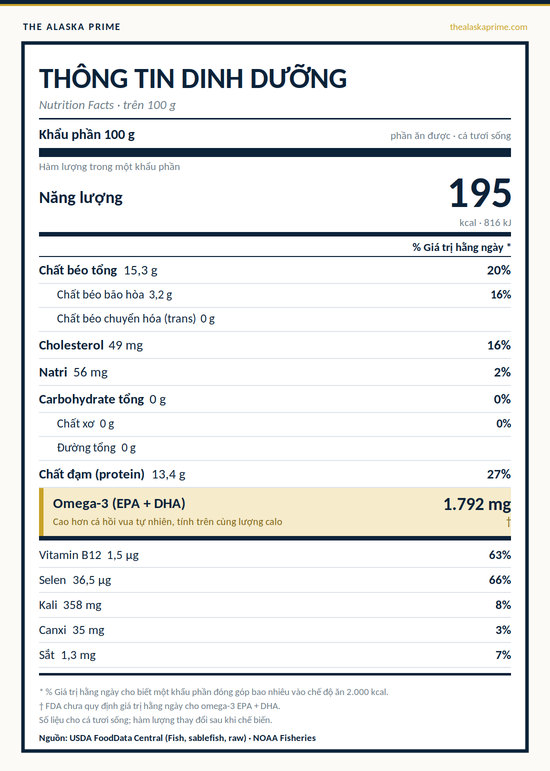
Raw black cod runs about 195 calories per 100g — 13.4g protein and 15.3g fat. Cooked, that rises to roughly 213 calories per 100g as moisture cooks off. But the number worth paying attention to isn't calories. It's omega-3s: 1,790mg of EPA+DHA per 100g, one of the highest concentrations of any commercial fish, and higher than typical farmed salmon.
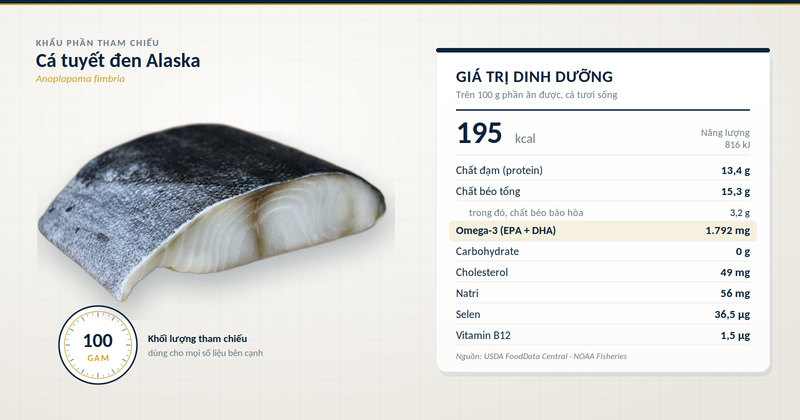
Black Cod Nutrition Facts (per 100g)
| Nutrient | Raw | Cooked | % Daily Value* |
| Calories | 195 kcal | 213 kcal | ~10% |
| Protein | 13.4 g | 15.2 g | 27% |
| Total fat | 15.3 g | 16.7 g | 20% |
| — Saturated fat | 3.2 g | 3.5 g | 16% |
| — Unsaturated fat | ~11.3 g | ~12.3 g | — |
| Omega-3 (EPA + DHA) | 1,790 mg | ~1,950 mg | Exceeds daily target |
| Carbohydrates | 0 g | 0 g | 0% |
| Fiber | 0 g | 0 g | 0% |
| Cholesterol | 49 mg | 53 mg | 16% |
| Sodium | 56 mg | 61 mg | 2% |
| Selenium | 36.5 mcg | ~38 mcg | 66% |
| Vitamin D | Significant | Significant | — |
| Vitamin B12 | Significant | Significant | — |
* Based on a 2,000-calorie reference diet. Sources: USDA FoodData Central (Fish, sablefish, raw and cooked); NOAA Fisheries.
How to read this: black cod is a fatty fish, not a lean one. Roughly 70% of its calories come from fat — but it's overwhelmingly unsaturated fat with an unusually high omega-3 share. That's why dietary guidance groups black cod with salmon, mackerel, and herring rather than with cod or pollock.
What About a Real Portion?
Nobody eats exactly 100 grams. Here's what actual servings look like.
| Serving | Weight | Calories (raw) | Protein | Omega-3 |
| Fillet portion (1 person) | 170 g | ~332 kcal | ~23 g | ~3,040 mg |
| Steaks for braising (2–3) | 200 g | ~390 kcal | ~27 g | ~3,580 mg |
| Kid's portion | 60 g | ~117 kcal | ~8 g | ~1,070 mg |
| Large fillet split 4 ways | 175 g each | ~341 kcal | ~23 g | ~3,130 mg |
| Sashimi (5–6 slices) | 80 g | ~156 kcal | ~11 g | ~1,430 mg |
What that means: a single 170g portion delivers around 3,040mg of EPA+DHA. Common dietary guidance suggests 250–500mg of EPA+DHA per day for healthy adults — so one black cod dinner covers roughly a week's worth.
Is Black Cod Fattening?
Black cod is high in fat, but not the kind that works against you — and it won't cause weight gain if you count it properly.
Three things to understand:
1. Most of the fat is unsaturated. Of 15.3g total fat, only about 3.2g is saturated. The rest is mono- and polyunsaturated — the category dietary guidance actively recommends in place of saturated fat.
2. It keeps you full. High protein plus high fat slows gastric emptying. You stay satisfied longer than you would on the same calories from carbohydrates.
3. The preparation matters far more than the fish. See below.
| Preparation | Est. calories / 170g | Notes |
| Steamed with soy | ~340 kcal | Adds essentially nothing |
| Broiled, no oil | ~350 kcal | Loses moisture, concentrates flavor |
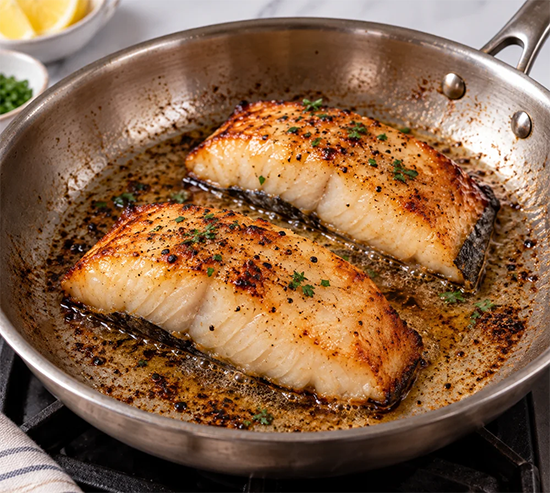
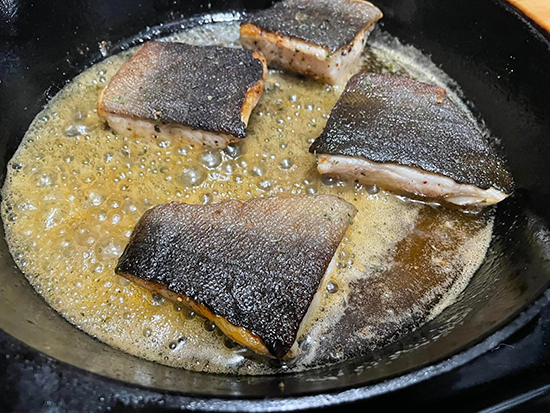
| Pan-seared, no added oil | ~350 kcal | The fish renders its own fat |
| Miso or teriyaki glazed | ~400–430 kcal | Sugar in the glaze adds 50–80 kcal |
| Braised with sugar and coconut water | ~430–480 kcal | The braising liquid is the calorie source |
| Battered and deep-fried | ~550–650 kcal | Not recommended for this fish |
Practical takeaway: if you're managing weight, black cod still works — just steam or sear it instead of glazing or frying. If low calories are your absolute priority, regular cod (69–82 kcal/100g) is the better tool; see our black cod vs. cod comparison.
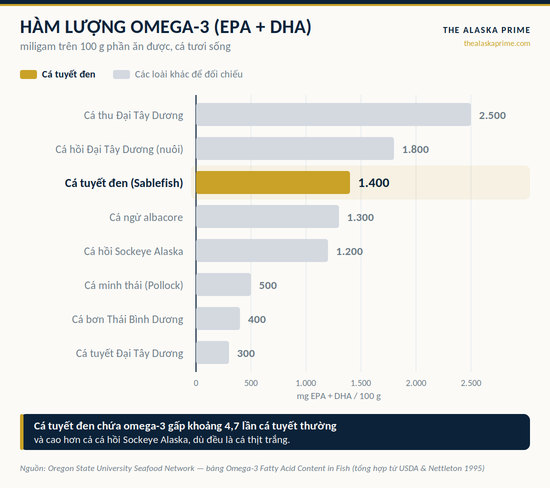
Black Cod vs. Other Fish on Omega-3s
Black cod sits near the top of the omega-3 rankings.
| Fish | Omega-3 EPA+DHA / 100g | Calories / 100g |
| Black cod (sablefish) | ~1,790 mg | 195 kcal |
| Wild sockeye salmon | ~1,200 mg | 168 kcal |
| Atlantic mackerel | ~2,600 mg | 205 kcal |
| Herring | ~1,700 mg | 158 kcal |
| Farmed Atlantic salmon | ~1,800 mg | 208 kcal |
| Halibut | ~400 mg | 91 kcal |
| Pacific cod | ~200 mg | 69–82 kcal |
| Pollock | ~400 mg | 92 kcal |
Source: USDA FoodData Central. Values vary by season and fishing ground.
Worth noting: black cod matches farmed Atlantic salmon on omega-3s while being entirely wild-caught — no formulated feed, no antibiotics. For anyone who wants both high omega-3s and a wild source, it's one of the few options that delivers both.
Looking at other wild omega-3 sources? See wild Alaskan sockeye salmon.
Health Benefits of Black Cod
These benefits trace back to nutrients black cod carries in unusually high amounts, based on well-established nutritional mechanisms.
Cardiovascular support. EPA and DHA are the two most-studied long-chain omega-3s in relation to triglyceride levels and vascular function. At 1,790mg per 100g, black cod is among the densest whole-food sources available.
Brain and eye function. DHA is a primary structural component of neural and retinal cell membranes — the reason dietary guidance emphasizes fatty fish for young children and older adults.
High selenium. A 100g serving supplies around 66% of the daily value. Selenium supports antioxidant enzyme systems and thyroid function.
Natural vitamin D. Very few foods contain meaningful vitamin D naturally. Fatty fish is one of the few — which matters for anyone with limited sun exposure.
Easy-to-digest protein with few pin bones. The soft texture makes black cod workable for older adults, people recovering from illness, and young children — groups that often struggle with bonier fish.
Zero carbohydrates. Fits cleanly into low-carb and keto approaches.
This is nutritional information, not medical advice. Anyone with an underlying condition, taking anticoagulant medication, or following a prescribed diet should talk to a doctor or registered dietitian before making dietary changes.
Who Should — and Shouldn't — Eat Black Cod Regularly
Especially good for:
- People who want more omega-3s but dislike strongly "fishy" fish
- Older adults and anyone recovering from illness — soft, easy to chew and digest
- Growing children — high DHA, few pin bones
- Anyone eating low-carb or keto
- People with limited sun exposure who need dietary vitamin D
Check with a professional first if you:
- Are tracking calories tightly — portion carefully or choose a leaner fish
- Take anticoagulant medication — high-dose omega-3s can interact
- Have been advised to limit fat due to gallbladder or pancreatic conditions
- Have a seafood allergy
On pregnancy and young children: black cod is a low-mercury, DHA-rich fatty fish and is generally considered a suitable choice. Recommended portions for pregnancy and children are covered in a separate guide.
Cooking Methods That Preserve the Most Nutrition
Steaming and moderate-heat broiling preserve omega-3s best. High-temperature deep-frying costs you the most.
Omega-3s are polyunsaturated — that structure degrades under high heat and prolonged oxygen exposure. Four practical rules:
- Favor steaming, moderate broiling, and quick searing. Avoid extended deep-frying above 180°C.
- Don't add oil to the pan. Black cod renders plenty of its own. Added oil raises calories without improving flavor.
- Cook it skin-on. The fat layer just beneath the skin is where omega-3 concentration peaks.
- Thaw it properly. Slow refrigerator thawing preserves moisture and fat structure. Hot water or microwave thawing drives out liquid and takes water-soluble nutrients with it.
See the full recipe collection at how to cook black cod, or pick your cut from Alaskan black cod.
Frequently Asked Questions
How many calories in one black cod fillet? A standard 170g fillet portion is about 332 calories raw. Steamed or broiled without oil, the plated figure lands around 340–350.
Is black cod high in mercury? No. Black cod falls in the low to low-moderate mercury category. It's a bottom-dwelling feeder, not an apex predator like swordfish or shark.
How often should I eat black cod? Common dietary guidance suggests two servings of fatty fish per week for adults. Given black cod's omega-3 density, one or two meals a week comfortably meets that.
Black cod or salmon — which is better? Both, and they complement each other. Black cod carries more omega-3 per gram than wild sockeye; sockeye brings astaxanthin and fewer calories. Rotating between them is the smartest approach.
Does freezing reduce the nutrition? Not meaningfully, when it's IQF frozen right after harvest. Most nutrient loss happens during improper thawing, not during freezing.
















)