Black cod only exists in the North Pacific — which means Norway doesn't have it at all. There are exactly two real commercial sources: Alaska and British Columbia, Canada. Anything sold as "Norwegian black cod" is almost always Atlantic cod or saithe wearing the wrong label. Between the two legitimate sources, Alaskan sablefish generally edges out Canadian on fat content — colder water, deeper harvest, and one of the tightest quota systems in the world.
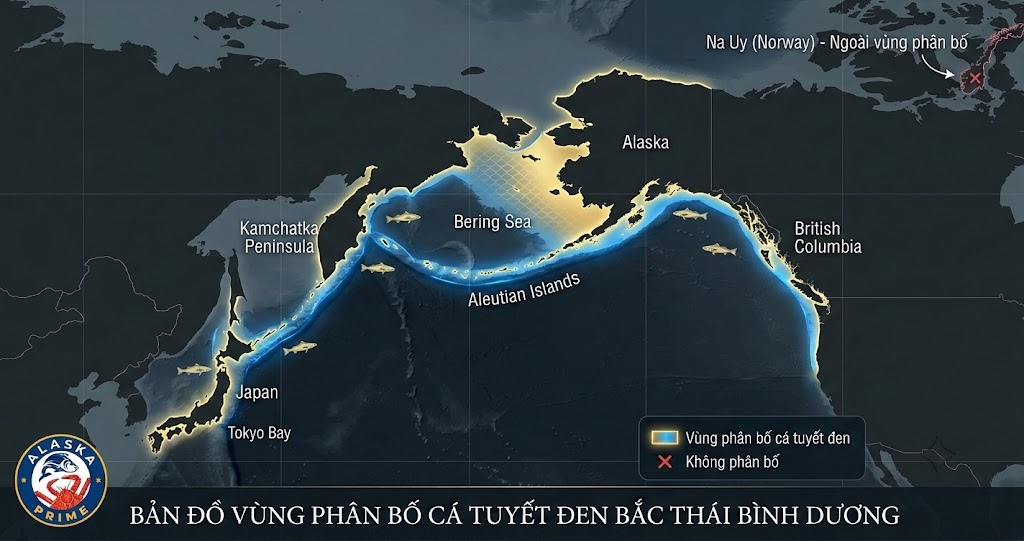
Map of black cod range across the North Pacific, with Norway marked outside the range
Does Norway Have Black Cod?
No. Blackcod — properly called sablefish, Anoplopoma fimbria — is native to the North Pacific only. Its range runs from Baja California up through Oregon, Washington, British Columbia, and Alaska, out along the Aleutians, into the Bering Sea, across to Russia's Kamchatka Peninsula, and down to southern Japan.
Norway sits in the North Atlantic. Different ocean, no overlap. There's no sablefish fishery in Norway and no commercial-scale farming operation there either.
So what is "Norwegian black cod"? Usually one of four things:
- Atlantic cod (Gadus morhua) — Norway's genuine cod, lean white flesh, a fraction of the price
- Saithe or coalfish (Pollachius virens) — the name "coalfish" translates awkwardly into several languages and gets confused with black cod constantly
- Real sablefish from Alaska or Canada that was processed or trans-shipped through Europe and labeled by port of departure
- An honest mistake by a retailer working from a bad translation
Number two causes the most confusion in Vietnamese market, since machine translation of "coalfish" produces the exact phrase Vietnamese buyers use as an alternate name for real sablefish.
Source Comparison
| Factor | Alaska (USA) |
British Columbia (Canada) |
"Norway" |
|
Has Anoplopoma fimbria? |
✅ Yes — largest stock worldwide |
✅ Yes |
❌ No |
| Waters |
Gulf of Alaska, Bering Sea, Aleutians |
Canadian West Coast |
North Atlantic (different ocean) |
| Water temperature | 2 – 4 °C |
4 – 7 °C |
— |
| Typical harvest depth | 400 – 1,000 m |
300 – 800 m |
— |
|
Average fat content |
Highest |
High | — |
|
Primary gear |
Longline, pot |
Trap, longline |
— |
|
Management |
NOAA Fisheries IFQ since 1995 |
DFO Canada individual quota |
— |
|
Sustainability mandate |
Written into the Alaska State Constitution |
Federal fisheries law |
— |
|
Common certifications |
Alaska RFM, MSC |
MSC |
— |
|
What you actually get |
Real sablefish |
Real sablefish |
Usually Atlantic cod or saithe |
Sources: NOAA Fisheries, Alaska Department of Fish and Game, FishBase.
Alaska vs. Canada: What's the Real Difference?
Both are the real thing and both are excellent. The differences come down to water temperature, harvest depth, and stock size — which translate into a modest gap in fat content.
Alaskan sablefish:
- Harvested in the coldest water anywhere in the species' range, typically 2–4 °C
- Deeper harvest, commonly 400–1,000 meters
- Colder, deeper water pushes the fish to store more fat — richer, moister on the plate
- Largest stock in the world, with a long season (roughly March through December) that keeps supply steady
- Managed under NOAA Fisheries' IFQ program, with per-vessel caps that ended the old race-to-fish
Canadian sablefish (British Columbia):
- Slightly warmer water, 4–7 °C
- Predominantly trap-caught, which is gentle on the flesh and lands the fish intact
- Still high in fat, just averaging a touch below Alaskan
- Smaller volume, mostly serving North American and Japanese buyers
Practical takeaway: the sensory gap between Alaskan and Canadian sablefish is small and hard to detect once cooked. What matters far more is documentation and freezing method. A slow-frozen Alaskan fillet loses to a properly IQF-frozen Canadian one every time.
Why Alaska Sets the Benchmark
Because Alaska is the only place on earth that wrote sustainable fishing into its state constitution. Article VIII, Section 4 requires that fish, wildlife, and marine plants be managed on the sustained-yield principle. That's a constitutional obligation, not a corporate pledge.
Three pillars behind the reputation:
- Individual Fishing Quotas. Since 1995, Alaska's sablefish and halibut fisheries have operated under NOAA's IFQ program — the largest catch share program in the United States. Each vessel fishes against an allocation, which removed the incentive to race for volume.
- Traceability. Landings are logged by trip and by management area. A legitimate importer can trace a lot back to the vessel and the grounds.
- Third-party certification. Alaska fisheries commonly carry Alaska RFM (Responsible Fisheries Management) and/or MSC certification, both assessed independently.
For a fish that lives 90-plus years and grows slowly, tight management isn't just an ethics story — it determines whether there's a supply left in twenty years.
How to Verify Origin Before You Buy
Don't trust the sticker. Ask for the paperwork. Six checks that work online or in person:
- Ask for the scientific name. It must be Anoplopoma fimbria. If the seller can't produce it, or answers Gadus morhua or Pollachius virens, it isn't black cod.
- Request the Certificate of Origin. Legitimate imports always carry one. For real sablefish, country of origin can only read USA or Canada.
- Check the Health Certificate issued by the exporting country's competent authority — NOAA/FDA for U.S. product.
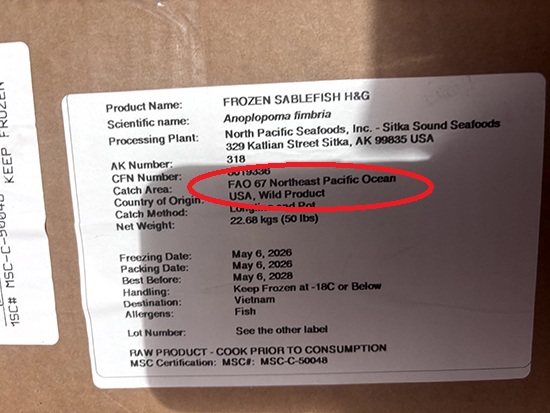
- Read the master carton. Look for "Sablefish" or "Black Cod" plus a catch area code. FAO Area 67 is the Northeast Pacific — correct. FAO Area 27 is the Northeast Atlantic — wrong ocean, wrong fish.
- Sanity-check the price. Real sablefish costs several times what Atlantic cod costs. A price that seems too good almost always means a different species.
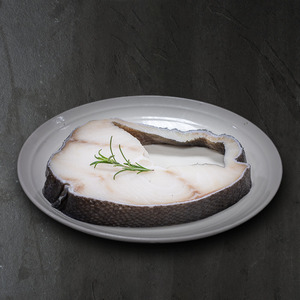
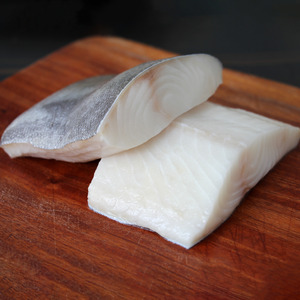
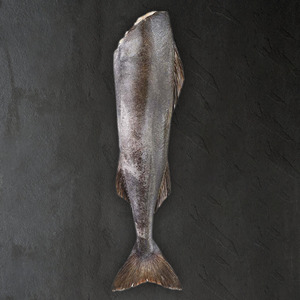
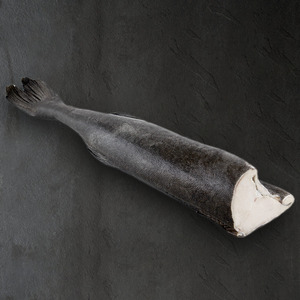
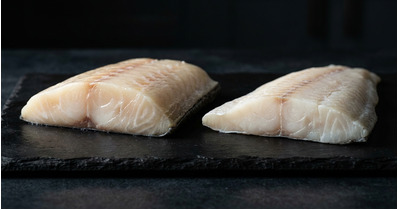
- Inspect the fillet. Thick cut, white fat lines running through the muscle, charcoal skin with a blue sheen, a wet sheen on the cut face. Full detail in our guide on telling black cod and regular cod apart.
Mislabeling Red Flags
|
What you see |
What it probably is |
Risk |
|
"Norwegian black cod" |
Atlantic cod or saithe |
🔴 High |
|
Scientific name Gadus morhua |
Atlantic cod |
🔴 High |
|
Scientific name Pollachius virens |
Saithe / coalfish |
🔴 High |
|
FAO Area 27 |
Northeast Atlantic — wrong ocean |
🔴 High |
|
Thin, chalky-white fillet, no marbling |
A different lean whitefish |
🟠 Medium |
|
Priced like regular cod |
Different species |
🟠 Medium |
|
No C/O, no scientific name |
Unverifiable |
🟠 Medium |
|
"Product of China" on retail packaging |
Possibly re-processed — ask about the raw material |
🟡 Ask more |
To be fair about that last row: it doesn't automatically mean counterfeit. A meaningful share of genuine Alaskan sablefish is shipped to China for filleting and re-exported — a legal, routine supply chain. What you need to confirm is where it was caught, not where it was packed
Which Source Should You Choose?
In order: (1) Alaskan sablefish with a Certificate of Origin, (2) Canadian sablefish with a C/O, (3) walk away from anything that can't produce a scientific name and an origin.
That ranking reflects actual risk, not brand preference. When the price gap between the real fish and its substitutes is this wide, documentation is the buyer's only real protection.
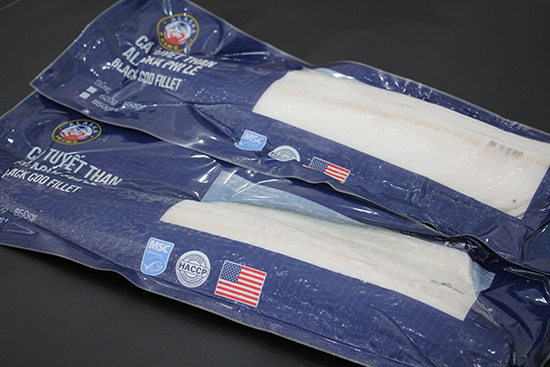
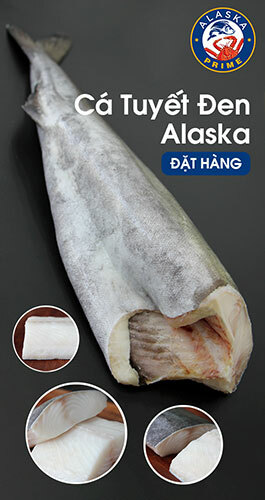
Every piece of black cod at The Alaska Prime is imported directly from Alaska through official channels, with full Certificate of Origin and health certification, IQF frozen piece by piece after heading and gutting at sea. Browse current cuts and sizes under Alaskan black cod, or explore our full range of imported Alaskan fish.
Got your fish? Head to what to cook with black cod next.
Frequently Asked Questions
Does Norwegian black cod exist? No. Anoplopoma fimbria lives only in the North Pacific. Norway is in the North Atlantic and has no sablefish fishery. Product sold under that name is typically Atlantic cod or saithe.
Is Canadian black cod worse than Alaskan? Not fundamentally. Both are genuine and high quality. Alaskan tends to carry slightly more fat because of colder, deeper water, but the difference is hard to detect once cooked.
What about Japanese black cod? Japan does have the species in its waters, but harvest volumes are small. Japan is overwhelmingly an importer of sablefish from Alaska and Canada, not an exporter.
Is China-processed sablefish lower quality? Not necessarily. Plenty of genuine Alaskan sablefish is filleted in China and re-exported — a legal and common practice. Verify where the fish was caught, shown on the Certificate of Origin and the FAO area code.













)